
Design for Humanity

When I was 16, I remember going in to a bookshop on the Upper West Side of Manhattan where I lived. It was a small space, but occupied two floors with a narrow staircase that went up to a second floor. Every space was packed with books. I had just received pay for my childcare work, and a bought a few books. I’ve been an avid reader since my teens.
One of those books became a favorite, one that I still have on the shelf after all those years: “Communitas: Means of Livelihood and Ways of Life” by Paul and Percival Goodman. I book about community planning and the choices of values that shape human societies. It was originally published in 1947 though my copy was the 1960 edition.
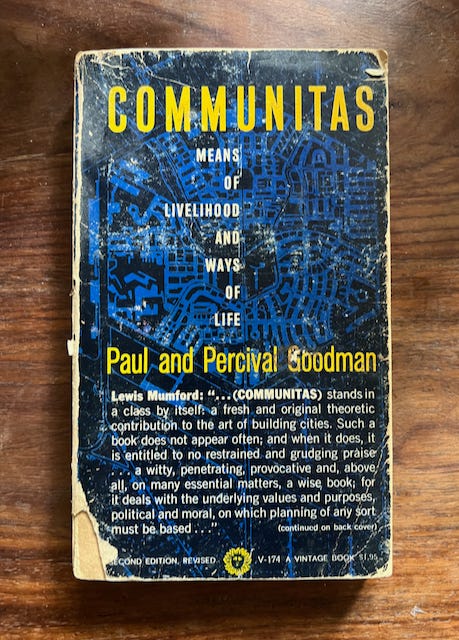
Its much more difficult to find a copy these days, but there is a good description on a Wikipedia Page https://en.wikipedia.org/wiki/Communitas_(book) .
Responding to the Bauhaus concept “form follows function”, here is what the Goodmans say about the design approach they call “Neo-functionalism” (p17-20).
“We therefore, going back to Greek antiquity, propose a different line of interpretation altogether: form follows function, but let us subject the function itself to a formal critique. Is the function good? Bona fide? Is it worthwhile? Is it worthy of a man to do that? What are the consequences? Is it compatible with other, basic, human functions? Is it a forthright or at least ingenious part of life? Does it make sense? Is it a beautiful function of a beautiful power? We have grown unused to asking such ethical questions of our machines, our streets, our cars, our towns. But nothing less will give us an esthetics for community planning, the proportioning of means and ends.”
Design is usually understood to be architecture, graphic, and industrial design. Social and economic conditions are taken as a given background and designers do not ask what can be done outside of the creation of a new product, building, or online resource. Most contemporary design is anti-elitist, taking the attitude that designed objects should be useful and placing for all people. But it is usually happy to live within the limits provided by society, law, and economy.
What happens when designers are no longer are satisfied with those limits? This is what the Goodmans are proposing. Can we turn, say, human centered design around and ask basic questions about the plan of our community, environmental, and economic systems? Design is going to be a lot less successful as a business if it questions the business frame. But it might be more successful at starting the kind of dialog that we need to be having now about how to change our society to be stainable.
I was really delighted when I started to read a book “Design for a Better World” by Don Norman https://mitpress.mit.edu/9780262047951/design-for-a-better-world/ one of the founders of the Human Centered Design movement. And there is a new online course from the Interaction Design Foundation https://www.interaction-design.org based on his book.
“If design got us into today's mess, perhaps it is design that can get us out, though not the way design is conceived of and practiced today. We need a new form of design, one that can work with the huge variety of issues, people, politicians, and businesses across the world. We need design as a way of thinking, of approaching large socio-technical systems, of recognizing each person as a component in the complex system of the world that comprises all living things, the earth, land, and sea, where each component impacts the others.” (p. 13)
Norman calls this “Humanity Centered Design”. If we are going to achieve a sustainable society, which we absolutely must do, we will need to do a heck of a lot of re-design or our everyday objects, transportation, community, architecture, and city planning.
Among other things will need to be able to conveniently and happily bring home food and supplies without generating a mountain of throw-away containers for each household. We need to work without spending one or two hours sitting in a car burning fossil fuel and spewing carbon into the air. We need to be serious about the fact that many of our major cities will be under water in decades to a century and design for new cities.
If we see these as design problems we can take this as our greatest opportunity to also make our society kinder, healthier, and better adapted to human needs.
Design professionals, in today’s world, do have very limited authority and rely on business and institutions for resources. One way to get this enormous task of redesign underway is to invite and teach everyone to be a designer. Automation, micro-scale manufacturing, and 3D printing are rapidly erasing the distinction between industrial design and craft. We can and should be teaching Humanity Centered Design in every high school.
I know a farmer who comes up with ingenious designs to solve problems on his small farm, and he adds value every time he adopts someone else's design. But he'll never put that genius to work to solve climate change, or hunger, or housing, because he lives in a culture where humans cannot, or should not, try to solve such problems.